What Is Flagging in Climbing?
Flagging uses your free leg as a counterweight to stay balanced on the wall. Learn the three types and when each one solves a balance problem.
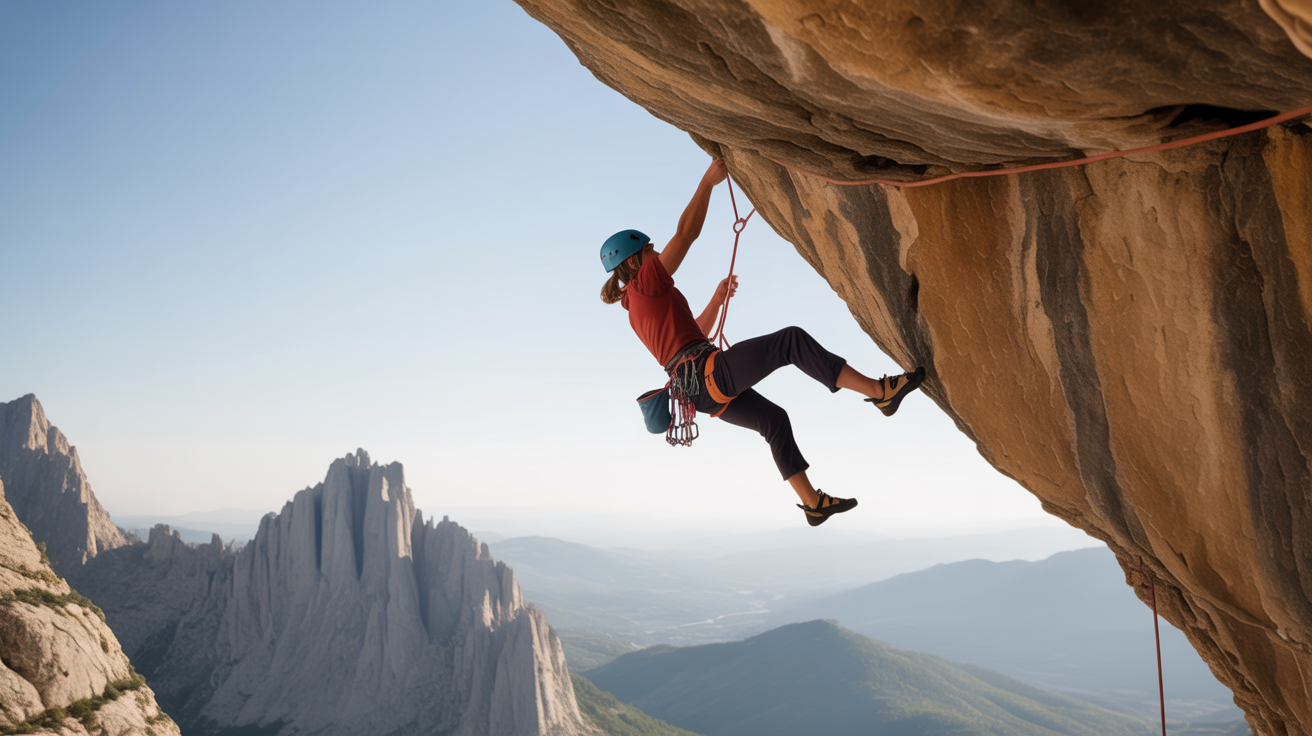
Flagging is one of those moves that separates climbers who look smooth from those who look like they're fighting the wall. It involves extending a free leg out to one side (or behind you) to shift your center of gravity and stay balanced over a foothold rather than swinging away from it.
You do not need exceptional strength to flag. You need an understanding of where your weight is going and which direction a leg needs to point to keep it there.
Why Balance Breaks Down Without Flagging
Most climbing moves are not perfectly symmetrical. You step on a foothold that sits to one side of your body, reach for a hold on the same side, and suddenly your hips want to rotate. That rotation pulls your body away from the wall in a motion climbers call barn-dooring: your torso swings open like a door on a hinge, your feet pop off, and you fall.
The underlying problem is that your weight has no counterbalance. One side of your body is loaded onto the wall while the other drifts into open space. To close the door, you need mass on both sides of the pivot point, which is usually the active foot.
Your free leg is the heaviest thing you can move quickly. Extending it in the right direction costs almost no extra effort, but it shifts several kilograms of weight and can completely neutralize the swing.
This is the whole logic behind flagging. It is body positioning, not strength. Getting comfortable with it will change how you read climbing technique for beginners more broadly, because balance and hip positioning underpin almost every other concept.
The Three Types of Flags
Climbers generally recognize three flagging variations. Each one applies to a different situation, and knowing all three means you can pick the right tool rather than guessing.
Inside Flag
An inside flag happens when you cross your free leg behind the active foot, placing it between your body and the wall. If your left foot is on a hold and you are reaching up and right, your right leg crosses behind to the inside, pressing gently against the wall or simply dangling there.
This works because the crossing motion rotates your hips toward the wall and inward, which is exactly the opposite of the barn-door swing. It is the most common flag for beginners to stumble onto naturally, because crossing the legs feels instinctive when the body is trying to rotate.
Outside Flag
An outside flag keeps the free leg on the outside of the active foot, extended away from the wall at roughly hip height or lower. Using the same example, left foot active, reaching up and right: your right leg extends out to the right rather than crossing behind.
This version works when the hold you are stepping on is positioned well to one side and crossing behind would be awkward or block your hip movement. Extending outward keeps the hips open and drops your center of gravity lower, which can make the move feel more stable even though the leg is not close to the wall.
Back Flag
A back flag sends the free leg straight behind you, pushing it back and down while you lean slightly forward into the wall. This is useful when you are on a steep section or a slightly overhanging face and need to push your hips in rather than sideways.
The back flag is less about lateral balance and more about counteracting the tendency to sag away from the wall on steep terrain. Think of it as a counterweight that helps your hips stay close so your arms do not have to pull as hard.
When to Use Each Type
Reading which flag to use comes with practice, but a few cues help you get there faster.
If you feel the barn-door swing beginning and your free leg is closer to the wall naturally, try an inside flag first. If the active foot is already well out to one side and your hips feel open, an outside flag often fits better. If the wall angle is steep and you are losing contact with the surface or your hips are drooping, experiment with a back flag.
Footwork fundamentals matter here too, because flagging only works if the active foot is placed precisely. A sloppy foothold placement means there is no stable pivot point to flag around. The two skills reinforce each other: precise feet give you a reliable fulcrum; flagging gives you the balance to trust it.
How to Practice Flagging on the Wall
The easiest drill is to find a simple route or boulder problem that you can already complete and deliberately slow it down. Move through each position and pause before each reach. Ask yourself: where is my weight going? Which direction does my free leg need to extend to keep me over my feet?
At first, you will probably over-flag, sending the leg too far and locking up your hip movement. That is fine. The goal is to build the habit of thinking about the free leg rather than ignoring it.
As you get more comfortable, you will start noticing natural flagging positions emerging without conscious effort. That is the skill becoming automatic, which is exactly where you want it.
One useful constraint: try completing a problem by touching each foothold with only one foot at a time. This forces you to use the free leg for balance rather than simply stepping onto the next hold, and it reveals how many positions are actually asking for a flag without being explicit about it.
Using your legs as your primary engine is a mindset shift that flagging reinforces. Your arms are for direction and position; your legs and hips are for power and balance. Flagging is one of the clearest expressions of that principle.
Common Mistakes Beginners Make
The most frequent error is not using the free leg at all. Many beginners keep both legs close together or let the unused foot dangle without purpose. On easy terrain this sometimes works, but on anything with sideways reach or hip rotation it falls apart quickly.
A second mistake is flagging too early or in the wrong direction. Flagging is a response to a specific balance problem in a specific position. Extending the leg before you understand where your weight is going can actually make things worse by sending your center of gravity further off target.
Third: flagging with a bent knee instead of an extended leg. A bent knee does not produce much counterweight because the mass stays near the center of your body. Extending the leg outward moves the weight where it needs to go.
Frequently Asked Questions
Do I need to flag on every climbing move?
No. Flagging is a tool for situations where your free leg has no foothold and your weight is drifting off-balance. On moves where you can place both feet on holds, you usually will. Flagging is most relevant when you are reaching sideways or up-and-across and only one foot has a hold to stand on.
Is flagging only for difficult routes?
It shows up on routes of all grades. Even on beginner terrain, some positions naturally call for a flag. The difference is that on easier routes you can sometimes muscle past the imbalance; on harder routes that is no longer an option, so the skill becomes visible.
Can I learn flagging on my own?
You can develop an understanding of it through deliberate practice on the wall, but having a coach or an experienced climbing partner watch you will accelerate the process considerably. They can spot when you are missing a flag opportunity and give you feedback in real time that is hard to self-diagnose. Climbing gyms regularly offer technique clinics that cover exactly these movement skills.
Does flagging work on overhanging walls?
Yes, though the geometry changes. On steep or overhanging terrain, a back flag is often more useful than a lateral one because the main challenge is keeping your hips close to the wall rather than preventing lateral barn-dooring. The underlying principle is the same: position the free leg to counterbalance where your weight is going.
Is there a safety consideration with flagging?
Flagging is a movement technique rather than a safety system. The safety fundamentals of climbing, learning to fall safely, using properly rated UIAA/CE certified gear, and working with a qualified instructor or gym on skills like belaying and lead climbing, remain separate and are not something an article like this can replace. If you are new to climbing, especially roped climbing, get hands-on instruction from a certified coach or experienced gym staff before moving onto routes where falls carry consequence.