Climbing Technique for Beginners: Move Like a Climber
Learn basic climbing technique fundamentals that matter more than strength: quiet footwork, straight arms, hip positioning, and drills to move better fast.
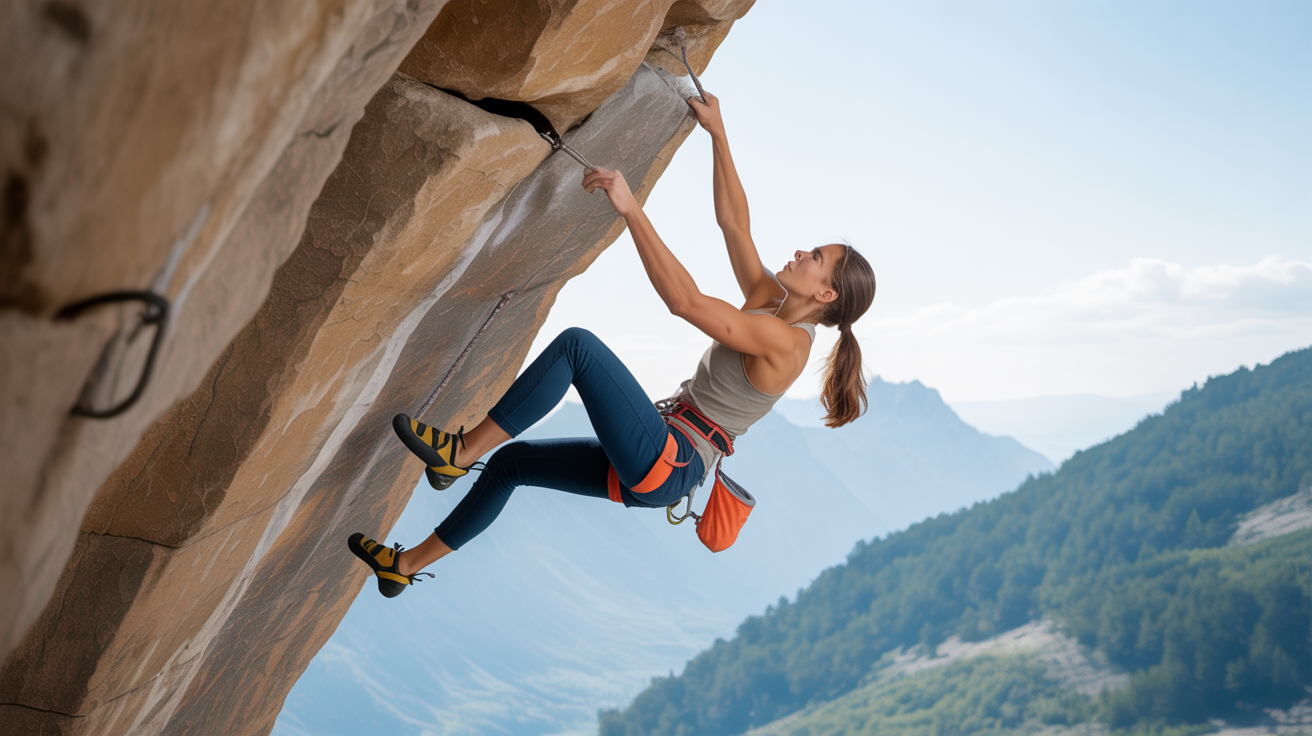
Most beginners assume climbing is about upper-body strength. Pull hard enough and you'll reach the top. In practice, the climbers who progress fastest are the ones who figure out early that technique saves far more energy than stronger arms ever could. The good news is that basic climbing technique is learnable from your very first sessions, and the payoff is immediate: less pump, more control, and routes that suddenly feel possible.
This guide covers the movement principles that coaches drill into beginners from day one. Work on these during easy climbs so the habits build before the routes get hard.
At a Glance
- Footwork is the highest-leverage skill you can practice, deliberate toe placement beats brute force almost every time.
- Straight arms let your skeleton, not your muscles, hold your weight between moves; bent arms should be a brief transition, not a resting position.
- Push with your legs and stand up onto your feet before you reach, don't pull your body up to meet a higher hold.
- Turning your hip toward the wall on a reach lengthens your reach and keeps your weight balanced instead of swinging out.
- Over-gripping usually comes from mistrusting your feet, not from weak forearms; fixing footwork fixes most of the grip problem.
- Drill one principle per session on routes well within your ability; technique compounds fastest when it isn't competing with difficulty.
Why Technique Matters More Than Strength
Walk into any gym and watch an intermediate climber next to a strong newcomer on the same route. The newcomer white-knuckles every hold and shakes out every few moves. The intermediate looks almost bored, stepping up calmly, pausing, reaching with clean efficiency.
The difference is rarely physical. It's movement literacy.
Climbing is a full-body skill, not a rowing machine. Your legs are the strongest muscles you own, and the wall is a surface your feet can push against. When you understand how to use that, the arms become steering, not engines. Pump, that burning forearm fatigue, is almost always a technique problem before it's a fitness problem. This is not a fringe opinion among coaches: Wikipedia's overview of rock climbing technique describes the same core principle, that effective climbing depends on "an effective body position and balance to maximize the conservation of energy," with arms kept straight so weight hangs on the joints rather than the flexed arm muscles, and the climbing itself driven by the stronger legs.
That said, technique isn't the whole story forever. Research into what actually determines climbing performance at higher levels has found that shoulder power and endurance explain most of the difference between climbers, with finger, hand, and arm strength, core endurance, flexibility, and balance as important secondary factors. None of that contradicts the advice to prioritize technique as a beginner. It means technique is what buys you efficiency and control right now, while a base of general strength and endurance becomes the thing that lets good technique translate into harder routes later.
Technique takes practice regardless. Reading about it only gets you so far. Get into a gym with qualified instruction, climb with more experienced people, and treat these ideas as a starting framework, not a final answer.
The Beginner's Default: Pulling Too Hard
New climbers grip the wall as if it might try to escape. They pull with both arms constantly and push with their feet only when they think about it. The result is that forearms are doing work they were never designed to sustain, and the feet, which can generate far more force, are mostly along for the ride.
Understanding this pattern is the first step toward breaking it.
Footwork: The Foundation of Everything
If you ask experienced climbers what separates beginners from intermediate climbers, most will say footwork before anything else. It is the highest-return skill to practice and the easiest to ignore when a route gets scary.
The principle is simple: place your foot deliberately, on a specific point of the hold, and trust it. Don't shuffle, scrape, or readjust. Pick your spot and commit.
Place the Toe, Not the Foot
Your climbing shoe is designed to transmit force through the tip of the big-toe area. That small contact point gives you precision and lets you stand on holds that a flat-footed placement would slip right off. When you're learning, exaggerate this. Think: tip of the toe on the center of the hold, every time.
On slab routes or footholds below your hips, you may use more of the shoe's edge or the middle of the sole, but the same rule applies: deliberate placement, not a rough approximation.
The Three Footwork Techniques Worth Naming
Coaches and route-setters use a handful of specific terms for how a foot contacts a hold. Knowing them helps you recognize which one a move is asking for.
| Technique | What it means | When it's used |
|---|---|---|
| Edging | Standing on the edge of the shoe, usually the inside edge near the big toe, on a small ledge or crystal | Vertical faces, small crimpy footholds |
| Smearing | Pressing the flat sole of the shoe against a featureless surface and relying on rubber friction alone | Slab routes, blank sections with no defined foothold |
| Jamming (feet) | Wedging the foot into a crack so it locks in place under body weight | Crack climbing, both indoors and outdoors |
Most gym routes ask for edging most of the time, with the occasional smear on a slab wall or volume. Recognizing which one a foothold calls for, rather than treating every foot placement the same way, is part of what separates deliberate footwork from guessing.
Trust Your Feet
The most common footwork mistake is not placing the foot wrong, it's not trusting the placement once you've made it. Beginners look down for a second, place a foot, then immediately transfer weight back to their arms because they're not confident the foot will hold.
This creates a destructive loop. The arms get tired because you never commit to the feet. The feet feel unreliable because you never test them. Breaking the loop means forcing yourself to weight your feet even when it feels uncertain. On a gym wall with rubber holds, your feet will almost never slip if you've placed them well.
For more on developing this skill, footwork-101-why-quiet-feet-matter-in-climbing covers silent feet drills and how to practice placing with real intention.
Keep Your Arms Straight and Hang Off Bone
This is the other technique principle that coaches repeat constantly, and it surprises most beginners: you should spend the majority of your time on the wall with your arms extended, not bent.
When your arms are straight, your weight hangs from your skeleton, your tendons, bones, and connective tissue, rather than your muscles. Your biceps can hold a bent-arm position for only so long before they give out. Your skeleton can support your bodyweight almost indefinitely, because bone doesn't fatigue.
What Hanging Straight Actually Feels Like
Stand at the base of the wall, grip a high hold, and let your arm go fully straight. Your shoulder drops, your elbow locks out, and your weight settles through the arm like you're hanging from a bar. That's the position.
Now imagine holding the same hold with your elbow at ninety degrees. Feel how the bicep engages? That's the position you want to avoid as a default. Save it for the instant you're moving through a sequence, then return to straight as quickly as possible.
Climbing with straight arms feels counterintuitive. It looks passive. But climbers who master this recover on the wall instead of pumping out, and they can stay on routes much longer as a result.
Push With Your Legs, Not Your Arms
The goal on every move is to get your foot onto a higher hold and push your body up with your leg, using your hands mainly for balance. This sounds obvious when you say it out loud, and yet most beginners do the opposite: they reach their hands to a higher hold and try to pull their body up to meet them.
The pull-with-arms approach burns out forearms and biceps fast. The push-with-legs approach taps into your glutes and quads, which are significantly stronger and don't fatigue at the same rate.
Moving Your Weight Over Your Feet First
Before you reach for the next hold, pause and check where your weight is. Is it over your feet, or hanging from your hands? If it's hanging from your hands, you're not ready to move yet.
The sequence for most moves looks like this: step your foot up, shift your hips over that foot until your balance is on the leg, then reach. When the reach happens from a balanced position, it's smooth. When it happens from a hanging position, it becomes a lunge that costs twice the energy.
The internal cue that helps many beginners: "stand up, then reach." Don't reach until you've stood up on your foot.
A common variation on this mistake is standing too far from the wall, hips back, torso leaning away, so even a correctly placed foot can't take much weight. Watch a beginner's knees: if they're pointed outward and the hips are hanging back over the heels, the leg can't drive upward efficiently no matter how solid the foothold is. Bringing the knee in and the hips toward the wall fixes this before you even touch the reach itself.
For a deeper look at this principle and some practical drills, use-your-legs-not-your-arms-the-beginner-s-secret walks through it with specific examples.
Hip Position: The Hidden Variable
Your hips are the heaviest part of your body. Where they go, your center of gravity goes. Most beginners leave their hips swung away from the wall, which means their weight is pulling them backward and their arms are working hard to compensate.
Getting your hips close to the wall changes everything. Suddenly your weight is over your feet, your arms need to do less, and the holds feel more solid.
Turning the Hip to Reach Further
On vertical routes, climbers often use a hip turn, called "flagging" in some contexts, to get the hip of the reaching arm closer to the wall. If you're reaching with your right hand, turn your right hip toward the wall. This does two things: it lengthens your reach by rotating your shoulder forward, and it keeps your center of gravity balanced rather than swinging out.
You can practice this on any straightforward route. Before you make a move, consciously turn the hip on the side you're reaching toward. It may feel awkward at first. Within a few sessions, it starts to feel natural.
A simple way to feel the difference: stand square to a wall and reach up and to the side as far as you can without turning your body. Note where your fingertips land. Now turn your same-side hip toward the wall and reach again. Most people gain several centimeters of reach purely from the rotation, with no extra stretching or strength involved. That gap is the whole reason flagging and hip turns show up on nearly every technique checklist.
Simple Drills to Build These Habits
Drills are how you engrain technique before difficulty strips away your ability to think. Practice these on routes that are well within your current limit, the goal is awareness, not performance.
| Drill | How to do it | What it fixes |
|---|---|---|
| Silent feet | Climb without making any sound with your feet, no scraping, no tapping for position | Rushed, imprecise foot placement |
| Straight-arm | Lock your arms out fully after every single move before reaching again | Staying pumped in a bent-arm position between moves |
| Hip-turn check | Before each reach, consciously rotate the hip on the reaching side toward the wall | Reaching from a square, swung-out stance |
| Weight-transfer pause | Pause for one breath before every reach and check whether your weight is over your feet | Reaching (and lunging) from a hanging position |
Run these on easy climbs two or three times per session. After a few weeks, they stop feeling like drills and start feeling like how you climb. It's worth resisting the urge to run all four at once on your first attempt. Pick one drill per session, let it get boring, then layer in the next. Trying to fix your feet, arms, hips, and weight transfer simultaneously on one climb usually means none of them stick.
Why Beginners Over-Grip (and How to Fix It)
Forearm pump is almost a rite of passage for new climbers. You get twenty feet up a route, your forearms turn into cannonballs, and your grip fails. It seems like a fitness issue. Often it isn't.
Over-gripping happens for two reasons: you're unsure if a hold will hold, and you're not trusting your feet enough to take weight off your hands. The grip compensates for both uncertainties by simply squeezing harder.
The fix is trust, built through repetition. As your footwork gets more reliable and your arms start to work in straight, hanging positions, you'll notice that you naturally grip lighter because you need to. The holds aren't going anywhere. Your feet are solid. Your arms are resting between moves. There's no reason to death-grip.
This is also why finding places to rest and shake out matters. On most routes, there are spots where a hold is good enough to hang off with one hand while you drop the other arm and shake it loose, getting blood moving back into the forearm. Learning to spot those rests and use them deliberately is a skill. Look for large holds, inside corners where you can lean into the wall, or low-angle sections where your feet can take most of the load. As a rough guide, a rest that lets you drop below roughly a third of your maximum grip effort for ten to fifteen seconds is usually enough to buy noticeably more climbing before you pump out; anything tighter than that barely helps.
FAQ
How do I know if my footwork is actually improving?
The best indicator is noise. If your feet are silent on the wall, your placements are deliberate. If you hear scraping and tapping, you're still feeling around rather than committing. Record yourself climbing occasionally, seeing your footwork from outside is usually more informative than how it feels from the inside.
Is it bad to bend my arms while climbing?
Bent arms have their place, you need them in the moment of pulling through a move. The problem is staying in that position between moves. Think of arm extension as your resting state and arm bending as a brief transition. If your arms are bent whenever you're stationary on the wall, that's where pump is coming from.
When should I start training my fingers more seriously?
Not in your first six months, and ideally not in your first year. Fingerboard training and hangboard routines are effective for experienced climbers, but the tendons and pulleys in beginner fingers haven't adapted to climbing loads yet. Training them aggressively too early is a reliable path to a pulley injury. Build your technique and let the gym climbing itself develop your finger strength gradually.
My legs shake on the wall. What's causing that?
Sewing-machine leg, that involuntary shaking, usually means your weight is too far back on the heel of your foot, or you're standing on a small foothold for too long in a semi-bent position. Try rolling your weight forward onto your toe and stand up straighter. If the shaking starts when you're static on a hard move, it's often a sign you need to move more dynamically rather than hovering in a difficult position.
How long does it take to develop good technique?
Technique develops throughout your entire climbing life, so there's no finish line. That said, most climbers notice a clear shift between sessions four and ten: the movement starts to feel less frantic, routes that felt impossible become manageable, and the pump arrives later. Deliberate practice accelerates this, climb below your limit, focus on one principle per session, and the pattern builds quickly.
Should I focus on technique or strength training first as a beginner?
Technique first, for at least the first several months. It's cheaper in terms of injury risk, it transfers to every route you'll ever climb, and most beginners have a large amount of "free" improvement available just from moving better. Strength and finger-specific training (like hangboarding) become genuinely useful once your movement is efficient enough that raw physical capacity, rather than wasted effort, is what's limiting you.
Climbing technique for beginners is really just learning to use your body in the order that makes physical sense: feet first, hips close, arms straight, reach from balance. None of it requires exceptional strength. All of it requires attention. Take it to the wall on easy routes, drill the basics until they're boring, and the harder routes will start to open up on their own.
For more on how body positioning unlocks better movement, see how-to-use-different-climbing-holds-crimps-jugs-slopers, understanding the holds you're working with is the natural next step once your movement fundamentals are in place.
The Climbing Primer is an independent educational resource. Climbing carries inherent risk of injury. This content is not a substitute for hands-on instruction from a qualified coach. Learn belaying, falling, lead, and outdoor skills in person, use properly rated (UIAA/CE) gear, and always check your systems and your partner.