The Buddy Check: Partner Checks Before You Climb
Learn what the climbing buddy check is, why it prevents serious accidents, and how to do a complete partner safety check before every single climb.
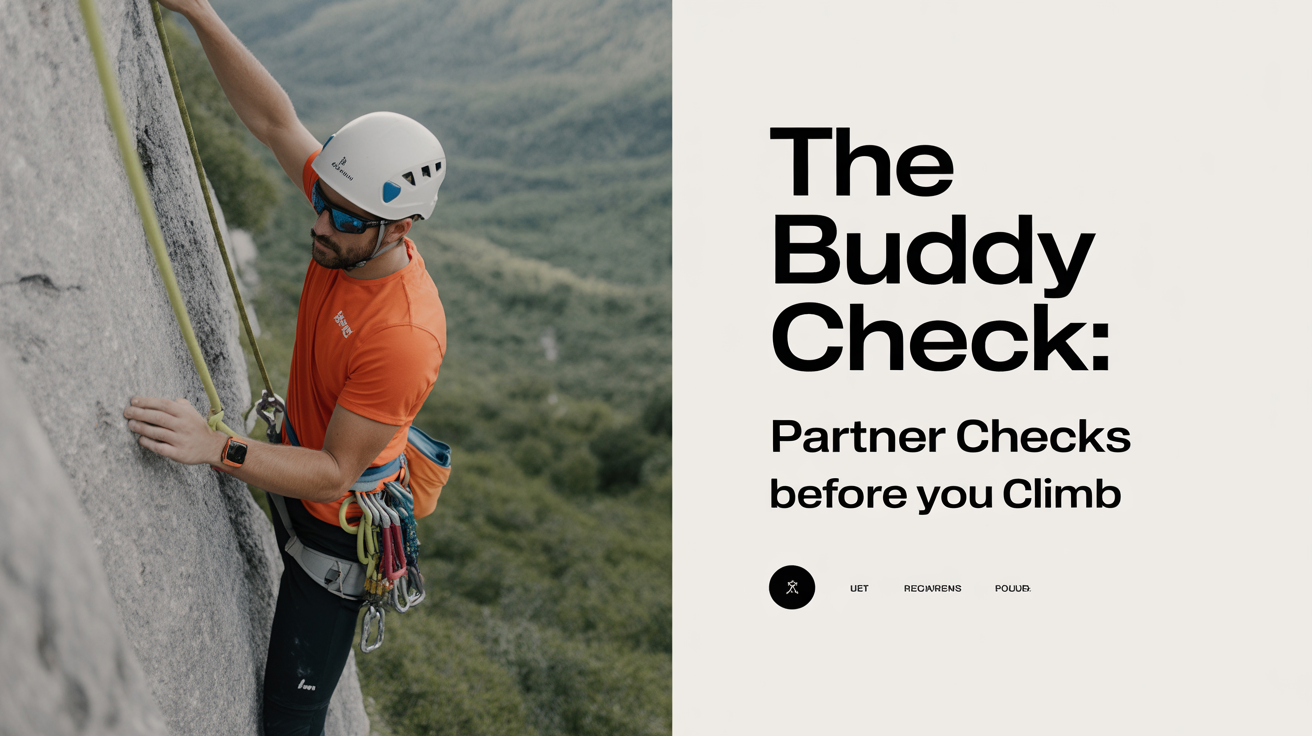
Before you leave the ground, there is one habit that separates careful climbers from careless ones. It takes about thirty seconds, it costs nothing, and research on gym accidents points to it again and again. That habit is the buddy check: a brief, out-loud inspection you and your partner do on each other's gear before every single climb.
This article explains what the buddy check covers, walks through a common checklist structure, and explains why even experienced climbers do it every time. Please note that reading about the buddy check is not a substitute for learning it in person. A certified gym instructor or belay class will teach you your gym's specific protocol and let you practice until it becomes automatic. Read this to understand the concept; then take the class.
What Is the Buddy Check and Why Does It Exist
The buddy check, sometimes called the partner check, is a mutual inspection where the climber checks the belayer's setup and the belayer checks the climber's setup. Both of you look at each other, not just yourselves.
That part matters. It is surprisingly easy to miss something on your own harness or your own knot because your eyes expect to see it correctly. A second set of eyes, especially a partner who is actively looking for problems, catches things you glide right past. Most serious gym climbing accidents are not caused by equipment failure or bad luck. They happen when a climber forgets to tie in completely, or a belayer loads the rope backward through the device, or a carabiner is left unscrewed. These are simple errors. The buddy check exists specifically to catch them before they become emergencies.
The check is also vocal. You name what you are looking at as you look at it. Saying "harness buckles, both doubled back and snug" out loud forces you to actually stop and confirm each item rather than rushing through a visual scan that does not really land.
A Common Buddy Check Sequence
Different gyms use different mnemonics and slightly different sequences. Your gym may use BARK, ABCDE, or another acronym. Whatever your gym teaches is the right one to use there. The items below reflect what most protocols cover; learn the exact order and language your gym uses in a belay certification class.
Here is a numbered checklist of what a typical buddy check covers:
- Climber's harness buckles. Check that the waist belt and both leg loops are doubled back (or auto-locking, depending on harness model) and snug against the body. Tug each buckle firmly to confirm it cannot pull through.
- Belayer's harness buckles. Same check on the belayer's harness: waist and legs, doubled back, snug.
- Tie-in knot. Inspect the climber's figure-eight follow-through. The knot is fully dressed (no crossed strands, no gaps), the tail is at least four inches long, and the rope passes through both the waist tie-in point and the leg loop tie-in point. Learn this knot step by step at how to tie in with the figure-eight follow-through knot.
- Belay device and rope loading. Confirm the rope is loaded through the belay device in the correct orientation, with the brake side correct and the rope not twisted or back-clipped. This varies by device. Your belay class will show you exactly what correct loading looks like on the device your gym uses.
- Locking carabiner. Check that the carabiner is attached to the belayer's belay loop (not a gear loop, not both loops), that the gate is closed, and that the locking sleeve is fully locked. Give it a firm twist to be sure.
- Rope end. Confirm there is a stopper knot in the end of the rope so the rope cannot run through the device if the climber reaches the top and lowers. Also confirm the rope length is sufficient for the route.
When you finish, both partners confirm verbally. Some gyms use specific calls like "on belay?" / "belay on." Review climbing commands every beginner should know for the full set of verbal cues that keep a climbing partnership coordinated from ground to top.
A Note on Mnemonics
Many gyms teach a mnemonic so you can recall the sequence without thinking. BARK (Buckles, Ask, Rope, Knot) and ABCDE (Anchor/Attachment, Buckles, Carabiner, Device, End of rope) are two common ones. Others exist. None of them replaces hands-on practice. The mnemonic is a memory jog, not a skill. The skill comes from doing the check repeatedly in a real class until your hands and eyes know what they are looking for.
How to Actually Do It: Slowly, Out Loud, Every Time
The biggest mistake new climbers make with the buddy check is rushing it. You glance at your partner's harness, say "looks good," and head for the wall. That is not a buddy check. That is wishful thinking.
Here is how a proper check actually runs:
Start on one partner, finish completely, then switch. Do not jump back and forth. As you inspect each item, say what you see: "Waist belt doubled back, yes. Left leg loop doubled back, yes. Right leg loop, yes, snug." Your partner is listening and watching, which means two brains are actively processing each point.
Work from top to bottom or bottom to top. Pick a direction and stay consistent so you do not skip anything. Take your hands with you: touch the buckles, tug the knot, twist the carabiner sleeve. Sight alone misses things. Hands confirm.
If something is wrong, stop and fix it before anything else. Thank your partner for catching it. That is exactly what the check is for.
The Time Pressure Trap
You will sometimes feel hurried. The gym is busy, your friends are already on the wall, and stopping for thirty seconds feels awkward. This is when complacency sneaks in.
The reality is that the accidents you are trying to prevent take far longer to recover from than any saved seconds at the base of the route. Thirty seconds, out loud, every climb — that is the standard. Experienced, competition-level climbers do it. Gym instructors do it. There is no level at which the buddy check becomes optional.
Where Buddy Checks Fit in Your Belay Training
The buddy check is part of belay certification, not something separate from it. When you take a belay class at your gym, an instructor will walk you through the check in the context of the full belay system: how the harness is supposed to fit, what a correct figure-eight looks like when fully dressed, what correct device loading looks and feels like. You will practice until the check feels natural, not slow and uncertain, but deliberate and confident.
If you have not taken a belay class yet, the partner check described here will not mean much in practice, because you will not yet have the reference point for what "correct" looks like. Enroll in a class first. You can read more about the full belay process at how to belay: a beginner's introduction.
Practicing Until It Is Automatic
New belayers sometimes feel like the buddy check takes concentration they want to spend on climbing. That feeling fades quickly once you have done the check fifty times. At some point your hands move through it efficiently and your brain is genuinely registering each item rather than narrating over a blur.
Get there by doing it seriously from the very first time. Treat every check in your first weeks at the gym as practice for building the habit, not just a formality before you climb. The climbers who skip it eventually are the ones who treated it casually from the start.
FAQ
Is the buddy check required at every gym?
Most climbing gyms with rope climbing require a buddy check as part of their belay certification rules. The specific protocol, and the mnemonic if one is used, varies by gym. When you get certified at a gym, they will teach you their version. Follow that version at their wall.
What if I am climbing with someone more experienced than me?
Do the check anyway. Experience does not make errors impossible. In fact, experienced climbers sometimes grow complacent precisely because things have gone right for so long. The check is mutual: you check them, they check you. Politely insisting on the check is not an insult to a more experienced partner; it is a sign that you take the shared responsibility seriously.
Can I do the buddy check on myself?
You can and should develop the habit of checking your own setup before your partner checks it. But self-checks do not replace the buddy check; they complement it. The whole point of the mutual system is that a second person catches what you missed on yourself.
What happens if we skip it and something is wrong?
Depending on what was missed, the consequences range from minor (a loose leg loop that is uncomfortable) to severe (an unthreaded tie-in knot or an unlocked carabiner). You will not know which until the error reveals itself, and some errors reveal themselves at the worst possible moment. Skip the check and you are gambling that nothing was wrong. The check costs thirty seconds. The alternative is not worth it.
How do I get comfortable asking my partner to do the check?
Just say it directly: "Ready to do a buddy check?" Most climbers respond positively, and at reputable gyms, asking for the check marks you as someone who climbs responsibly. If a partner pushes back or tries to skip it, that is a signal worth paying attention to. Your safety depends on their setup; you have every right to verify it.
The buddy check is one of the simplest things in climbing and one of the most important. Thirty seconds, out loud, both directions, every time you leave the ground. Learn the protocol in a belay certification class at your gym, practice it until it is automatic, and do not let routine make you sloppy. The climbers around you will notice.
The Climbing Primer is an independent educational resource not affiliated with any gym, brand, or organization. Climbing carries inherent risk. This content does not substitute for hands-on instruction from a qualified instructor. Learn belaying and safety systems in person, use properly rated (UIAA/CE) gear, and always check your systems and your partner.