How to Tie In: The Figure-Eight Follow-Through Knot
Learn how the figure-eight follow-through knot works, why it's the standard tie-in, the exact steps, common mistakes, and why a buddy check is non-negotiable.
Before you ever leave the ground on a roped climb, one piece of knowledge matters more than any footwork technique or grip strength exercise: how to tie yourself to the rope. The figure-eight follow-through is the knot that does that job. It is the standard tie-in knot used by gym climbers, sport climbers, and trad climbers around the world, and for good reason. It is strong, reliable, and easy to inspect once you know what a finished knot should look like.
This article explains how the knot works, walks through each step, covers the checks you need to do, and flags the mistakes beginners make most often. Read it, study the photos in your gym's instruction materials, and then practice with a qualified instructor before you ever weight the rope. This is educational content. It is not a substitute for hands-on learning under the guidance of someone who can watch your hands, catch your errors, and sign off that your knot is correct.
Why the Figure-Eight Follow-Through Is the Standard Tie-In
Most gyms require this knot. Most certified climbing courses teach it first. That consistency exists for a reason.
The figure-eight follow-through is a retraced knot, meaning you form the basic shape first and then trace it a second time with the tail of the rope. That retracing action makes it extremely strong, distributes load well across both tie-in points on your harness, and results in a finished knot that is bulky enough to be visually obvious. A trained eye can confirm in seconds whether it looks right.
Why Not Other Knots?
Other knots work. Bowlines have their proponents, and the double bowline is used by many experienced climbers. But for a beginner, the figure-eight follow-through wins on two counts: it is harder to tie incorrectly in a way that looks finished, and it is easier for a partner to inspect. That inspectability is a real safety feature. Before you climb, your partner will look at your knot. The more recognizable its correct form, the more useful that check becomes.
This Is a Life-Safety Skill -- Learn It in Person
Everything in this article is accurate to the best of our knowledge, but words on a screen cannot replace a qualified instructor watching your hands. Tie the knot in front of a certified climbing coach, a guide, or a knowledgeable gym staff member before you trust it with your life. That conversation needs to happen in person.
What You Need Before You Tie In
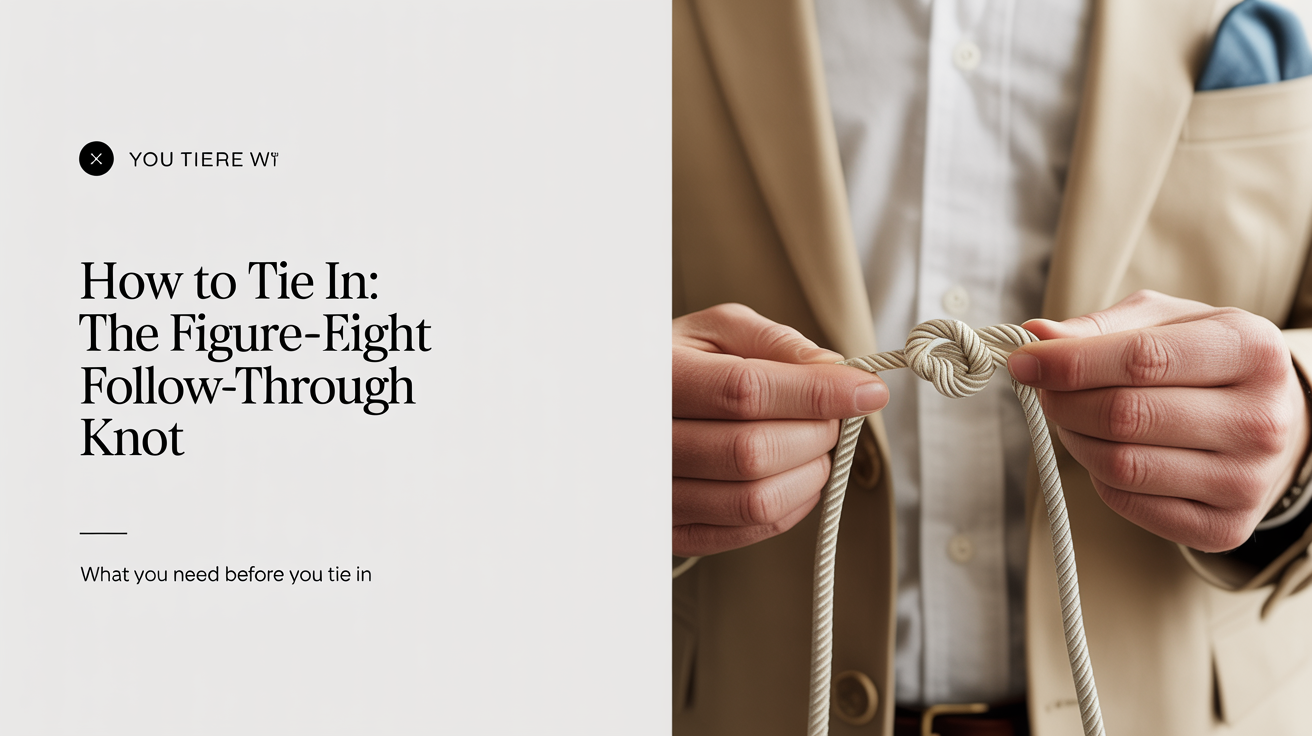
You need a properly fitted harness with two labeled tie-in points. These are typically marked by the manufacturer and are the loops that the belay loop connects to. Do not tie into the belay loop itself; do not tie into a gear loop. Read your harness manual. If you are not sure which points to use, ask a gym staff member before you start.
You also need a single rope with a climbable end and enough tail to work with. About an arm's length of rope from the end is the right starting length for the knot itself.
How to Tie the Figure-Eight Follow-Through, Step by Step
Work slowly the first many times you practice. Speed comes later. Accuracy matters now.
-
Measure your tail. Hold the rope end. Feed out roughly an arm's length of rope (about 50 to 60 cm for most people). Pinch the rope at that point with your non-dominant hand. The section from your pinch to the end is your working tail.
-
Form the initial figure-eight. Working with the tail section, make a loop by crossing the tail over the standing rope. Wrap the tail around the back of the standing rope once. Then thread the tail up through the original loop. You now have a figure-eight shape in the rope. The crossing pattern should look like the number 8: two loops, a twist in the middle, with the tail coming out the top.
-
Thread through your harness tie-in points. Take the tail end and feed it through both tie-in points on your harness, following the order your harness manufacturer specifies. Go through the waist loop tie-in point first, then the leg loop tie-in point (or the reverse, per your harness model). Thread from the inside outward so the rope path mirrors how a manufacturer's factory knot would sit against your body.
-
Retrace the eight. This is the follow-through step. Starting from the point where the tail exits your harness, guide the tail back into the knot alongside the rope that is already there. You are tracing every strand of the original figure-eight in reverse, adding a parallel strand alongside each existing one. Work methodically: follow the path of the original knot without crossing strands.
-
Dress the knot. Pull each strand so that parallel strands lie flat and side by side. No strand should cross over another. Gaps or crossings mean the knot is not properly dressed and needs to be corrected before climbing.
-
Snug it up. Pull the standing rope, the tail, and the loops near the harness in turn to tighten the knot down. It should feel firm and compact. A loose, floppy knot is wrong.
-
Check your tail. The tail exiting the knot should be roughly a fist-length, about 10 cm (four inches) minimum. Too short means the knot is either undertied or may work loose under load. Too long is fine; a short tail is not.
-
Do the five-pair check. Count the visible pairs of parallel strands. A correctly tied figure-eight follow-through has five distinct pairs of parallel strands. Count them deliberately before calling the knot done.
What a Finished Knot Looks Like
The finished knot is bulky, roughly symmetrical, and tight against the harness. Both tie-in points should have rope running through them. The knot body should sit against your hip, not dangling down. If any part of it looks loose, gapped, or lopsided, untie it and start again.
The Buddy Check: Not Optional
Before you leave the ground, your partner checks your knot. You check theirs. Every time. No exceptions.
A buddy check is not a polite formality. It is the last line of defense against a mistake that could cost you your life. Experienced, certified climbers still do buddy checks on every single route. If you ever climb with someone who skips this step, that is a serious warning sign.
During the check, your partner should confirm:
- Both tie-in points have rope through them
- The knot body is a clean, dressed figure-eight shape
- Five pairs of parallel strands are visible
- The knot is snug, not loose
- The tail is at least a fist-length long
Then you check their harness buckles and belay device setup before they check yours. The full process takes about thirty seconds and it matters every time.
For a thorough walkthrough of what to look for, read our guide to the buddy check. You should also get familiar with climbing commands so the communication between you and your partner is clear from the moment you start.
Common Mistakes Beginners Make
Most tie-in errors fall into a handful of categories. Knowing what they are helps you catch them in yourself.
Threading through the wrong harness points. The belay loop is not a tie-in point. Gear loops are not tie-in points. Only the two labeled tie-in points (the ones the belay loop connects to) are correct. Threading anywhere else is dangerous.
Skipping one tie-in point. Both points must have rope through them. Threading through only the waist belt or only the leg loop is a serious error. Some beginners do this because they misread the harness or lost track of where they were.
Rethreading the wrong way. When you follow the tail back through the knot, it must trace exactly alongside the existing strands, not cross them. A strand that crosses instead of parallels means the knot is malformed. A correctly retraced knot looks like every strand has a twin.
Crossed strands in the finished knot. Crossed strands mean the knot was not dressed properly. Pull the strands apart and press them into parallel alignment. If the knot is too tight to dress, untie it and redo it before it is fully tightened.
A tail that is too short. If your tail after completing the knot is less than about four inches, either you started with too little rope or the knot is not fully tied. A short tail is a real hazard. Untie and redo with more starting length.
Skipping the buddy check. This is perhaps the most common and most dangerous mistake. Tying the knot correctly is necessary but not sufficient. You must get a partner check before you climb.
Practice Until It Is Automatic -- Then Still Get Checked
The goal with any safety-critical skill is to reach the point where the correct steps feel natural, where your hands find the right path without you having to think through each step consciously. That kind of fluency comes from repetition. Tie the knot on a rope at home. Tie it at the gym before sessions. Tie it with your eyes closed until you can feel whether the strands are parallel or crossed.
But -- and this is important -- fluency does not eliminate the need for oversight. Even experienced climbers get complacent. Even people who have tied this knot thousands of times have occasionally made an error that their partner caught. The buddy check exists precisely because humans get tired, get distracted, and make mistakes.
Learning to belay safely goes hand in hand with learning to tie in. Read our introduction to belaying to understand how the whole rope system works together before you start climbing with a partner.
The Climbing Primer is an independent educational resource and is not affiliated with any gym, brand, or certification organization. Climbing involves inherent risk of serious injury. This article is not a substitute for hands-on instruction from a qualified instructor.
FAQ
Is the figure-eight follow-through the only knot I can use to tie in?
It is the most widely taught and most widely accepted tie-in knot for beginners, and most gyms require it. Other knots, like the double bowline, are used by experienced climbers. While you are learning, stick with the figure-eight follow-through. Master one knot correctly rather than sampling several halfway.
How do I know if I threaded through the right harness points?
Your harness manual will identify the tie-in points clearly, and they are almost always marked with labels or icons on the harness itself. They are the two points that the belay loop connects to. When in doubt, ask a gym staff member before you tie in. Do not guess on this.
What if my tail is too short after I finish the knot?
Untie and start over. A short tail means either you started with too little rope or the knot is incomplete. Never climb with a tail shorter than about four inches. Retie with a longer starting length.
Do I need to do a buddy check even in a gym with top-rope auto-belays?
Auto-belay systems do not involve a partner checking your tie-in because you clip into a carabiner or hook, not a knot. But for any partner-roped climb, a mutual buddy check is mandatory. Get into the habit regardless of setting.
How long does it take to learn this knot properly?
Most people can tie a passable figure-eight follow-through after a few sessions of practice. Tying it correctly, quickly, and consistently in all conditions takes longer. Take a beginner course at your gym, practice regularly, and ask a staff member or instructor to verify your knot regularly in your first weeks of climbing.