Straight Arms and Resting Positions on the Wall
Learn why straight arms save energy on the wall, how to find rest stances, shake out your forearms, and read a route for hidden rests.
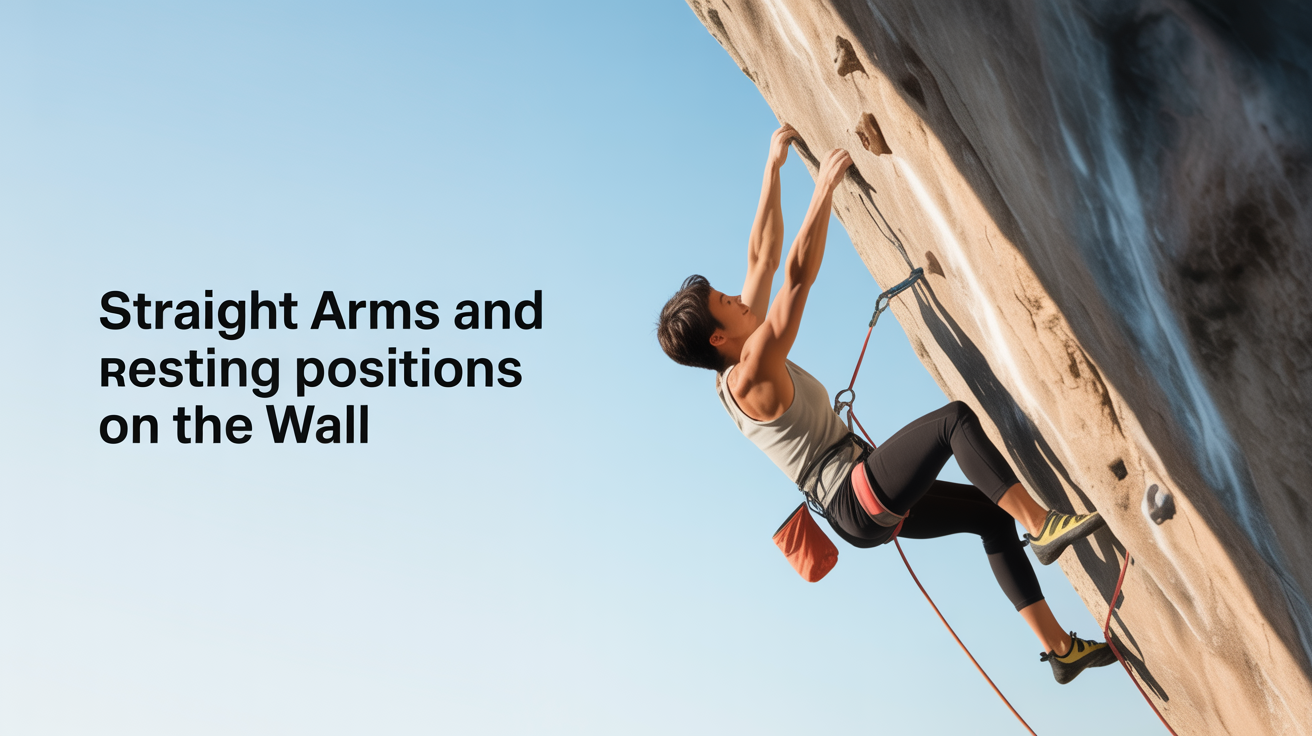
If you finish a climb with forearms that feel like concrete, the usual culprit is not a lack of strength. Most beginners grip too hard and keep their arms bent far longer than necessary. Learning to hang on straight arms and locate rest stances on the wall makes a bigger difference in stamina than almost any training you can do in the early months.
Why Straight Arms Change Everything
When your elbow is bent, your bicep and forearm flexors are under load. Hold that position for ten or fifteen seconds and those muscles start to fatigue. When your arm is fully extended, the load shifts to your skeleton. Bones hold weight passively; they do not tire the way muscle tissue does.
This is the core principle behind "hanging on your bones." Think of it as standing upright versus doing a half-squat all day. The squat burns out your legs quickly. Standing, the skeleton carries you.
In practice, straight arms mean you drop your hips slightly away from the wall, let your arms reach long, and allow your weight to settle into your shoulder joints rather than your biceps. Your hands become hooks rather than levers. The grip is firm enough to stay on the hold, not so firm that your forearm is constantly contracting.
New climbers often pull themselves tight to the wall because it feels more secure. The opposite is usually true. A little distance between your hips and the rock gives your arms room to straighten and lets your legs take over more of the work. For a deeper look at how that body positioning plays out across different holds and wall angles, Technique for Beginners: Move Like a Climber covers the full picture.
Finding Rest Stances on a Route
A rest stance is a position where you can momentarily stop pumping and let blood return to your forearms. Spotting them before you leave the ground is a skill that improves with deliberate practice.
Look for large footholds at roughly hip or knee height. When you can stand on big holds, you can transfer weight off your hands entirely for a few seconds. Slab sections and lower-angle corners tend to offer the best rests because the wall angle itself takes some of the load.
Stemming corners are particularly valuable. When both feet press outward against two faces of a corner, your legs can hold you in place with very little hand pressure at all. Even a few seconds in a stem rest can flush enough lactic acid from your forearms to keep you moving.
Knee bars, heel hooks, and toe hooks can also free up your hands if the route geometry allows it. A knee bar that locks in properly lets you hang completely hands-off. These take practice to find and set reliably, but even a partial knee bar reduces arm load substantially.
The habit to build is route reading from the ground. Scan the line for holds that look large, for corners, for edges you could stand on with your weight balanced. Mark those spots mentally and think about what position you will be in when you reach them. Arriving at a rest stance already knowing what to do is far more effective than recognizing it in the moment when you are already pumped.
How to Shake Out Your Forearms
Shaking out is exactly what it sounds like: you hang on one arm, drop the other, and let it hang low while gently shaking the hand. The downward position and gentle movement encourage blood flow back into the forearm.
Effectiveness depends mostly on arm position. Your hand needs to be below your heart for gravity to help drain the waste products out. If you shake while your arm is still at chest height, the benefit is minimal. Drop it fully.
Switch arms every fifteen to thirty seconds. Do not rush through the shake. Breathe normally. Some climbers find slow circles with the wrist help more than shaking; try both and see what works for you.
If both hands are on holds and you cannot fully release one, you can still ease the grip on whichever hand is more rested. Alternate which hand takes the majority of the load.
The G-Tox for Faster Recovery
The G-tox is a technique developed to speed forearm recovery during a rest. Instead of letting your arm hang passively, you alternate between raising it above your head and dropping it below your heart in a slow rhythmic motion.
The theory is that the pressure differential created by cycling between high and low positions moves blood through the forearm more actively than a static hang. Whether or not the physiological explanation holds up precisely, many climbers find it noticeably speeds recovery compared to simple arm-drop shaking.
To do it: hang on one hand, raise the free arm above your head for a few seconds, then swing it down below heart level, then repeat. The rhythm is slow, about one cycle every four or five seconds. Keep the resting arm relaxed throughout.
Experienced climbers often look like they are waving at someone during hard routes. They are G-toxing on a rest.
Reading a Route for Rests Before You Climb
Route reading is the habit of studying a line from the ground before you start. For beginners this often means tracing holds and thinking about sequences. Adding rest identification to that process pays off immediately.
Ask yourself: where can I stand on my feet with both hands light? Where is there a corner I can stem? Where does the wall angle ease off? Are there any big features I can lean into?
On overhanging routes, rests are rarer and demand more creativity. A kneebar or a deep back-step that lets you drop a hip can create a moment of reduced arm load even on steep terrain. On vertical and slab routes, rests are plentiful if you look for them.
Mark two or three candidate rest positions per route. When you arrive at the first one, commit to actually stopping for fifteen to thirty seconds rather than rushing through. Climbers often pass rest stances because they feel okay in the moment. By the time they wish they had stopped, they are too pumped to use the next one well.
Footwork plays a direct role here too. You cannot stand on a rest hold effectively if your feet are sliding off it. Good footwork makes every rest more useful. Footwork 101: Why Quiet Feet Matter in Climbing explains the mechanics behind precise foot placement, which directly extends how long a rest stance actually rests you. And the broader reason footwork and resting matter is the same: legs are far stronger and more endurance-capable than arms. Use Your Legs, Not Your Arms goes into why beginners over-rely on upper body and how to start correcting it.
A Note on Safe Practice
The techniques in this guide are part of movement skill development, which is best built in a gym environment where you can try, fall, and learn without additional risk. If you are new to top-rope or lead climbing, getting hands-on instruction from a qualified gym staff member or instructor is essential before working on wall time. A trained eye can catch gripping habits and body positioning issues that are difficult to self-diagnose. Use UIAA or CE-certified shoes, chalk, and any other gear your gym recommends, and always complete a full partner check before leaving the ground.
Frequently Asked Questions
Why do my forearms pump even when I try to use straight arms?
Straight arms help, but grip tension matters just as much. If you are squeezing holds as hard as you can while your arms are extended, the forearms still fatigue. Practice consciously loosening your grip on each hold just enough to maintain contact. On larger holds, open-hand grip uses less force than a closed crimp and reduces pump over a full route.
How do I know if I am actually resting or just pausing?
A real rest involves blood returning to your forearms, which means the tight, full feeling should ease over ten to thirty seconds. If your forearms are still worsening after thirty seconds on a rest stance, either the stance is not effective enough (you may still have too much weight on your hands) or you are too pumped to recover at that point. Aim to reach rests before you are fully pumped rather than after.
Is the G-tox better than a simple arm drop?
For many climbers, yes, but it requires a stable enough rest stance to alternate arm positions without losing balance. If your rest is a small edge where you need both hands for security, a simple arm drop is better than nothing. Use the G-tox when you have enough security to move both arms deliberately.
Should I always look for rests on easier routes too?
Yes. Easier routes are the best place to build the habit because you have time and security to actually stop and practice shaking out. By the time routes get hard enough that rests are critical for survival, the habit of identifying and using them should already be automatic.
How long does it take to rebuild forearm endurance after a rest?
It depends on how pumped you were going into the rest and how effective the rest stance is. A mild pump can clear in fifteen seconds on a good stem. A severe pump may need sixty to ninety seconds even on an excellent rest. Over time, your forearms will recover faster as your fitness improves, but the rest position quality matters more than time spent resting.