How to Fall Safely While Bouldering
Learn the correct bouldering fall technique: bent knees, backward roll, no reaching back. Plus common mistakes and how to practice safe landings.
Falling is not the failure state in bouldering. It is the default state. Every serious boulderer falls dozens of times in a single session. What separates a bumped ankle from a broken wrist is almost always technique, and technique is something you can actually practice. If you are new to the sport, learning how to fall well is just as important as learning how to move on the wall, and honestly it pays off faster.
This guide covers the fundamentals of safe bouldering landings: what to do with your body on the way down, what not to do, and how to build the habit before it matters. It is educational in nature and is not a substitute for hands-on coaching. If you are training at a gym, ask an instructor to watch your falls. A few minutes of feedback from someone who can see your body position is worth more than any article.
The Climbing Primer is an independent resource and is not affiliated with any gym, brand, or organization. Climbing carries inherent risk of injury; treat this content as a starting point, not a complete safety system.
Why Falling Technique Matters
The most common bouldering injuries are ankle sprains and wrist fractures. Both happen for the same underlying reason: climbers try to stop or control the fall rather than let the body absorb it efficiently. A stiff-armed catch against the floor concentrates the entire impact load onto your wrist joint, which is not designed for it. Landing with locked knees sends the same force straight up through your ankles and knees.
The goal of good falling technique is to spread the impact across a larger area over a longer time, the same principle that makes crumple zones work in cars. Bent joints, a backward roll, and relaxed muscles all accomplish this. None of it requires exceptional athleticism. It requires a habit you build deliberately from low heights.
The Most Dangerous Reflex to Unlearn
Your brain will instinctively throw your hands out when you start to fall. This reflex is helpful on flat ground, but on a bouldering pad it creates exactly the wrong outcome. Fight it consciously until the better movement becomes automatic. Many coaches describe this as the single most important thing beginners need to practice.
The Correct Bouldering Fall Technique
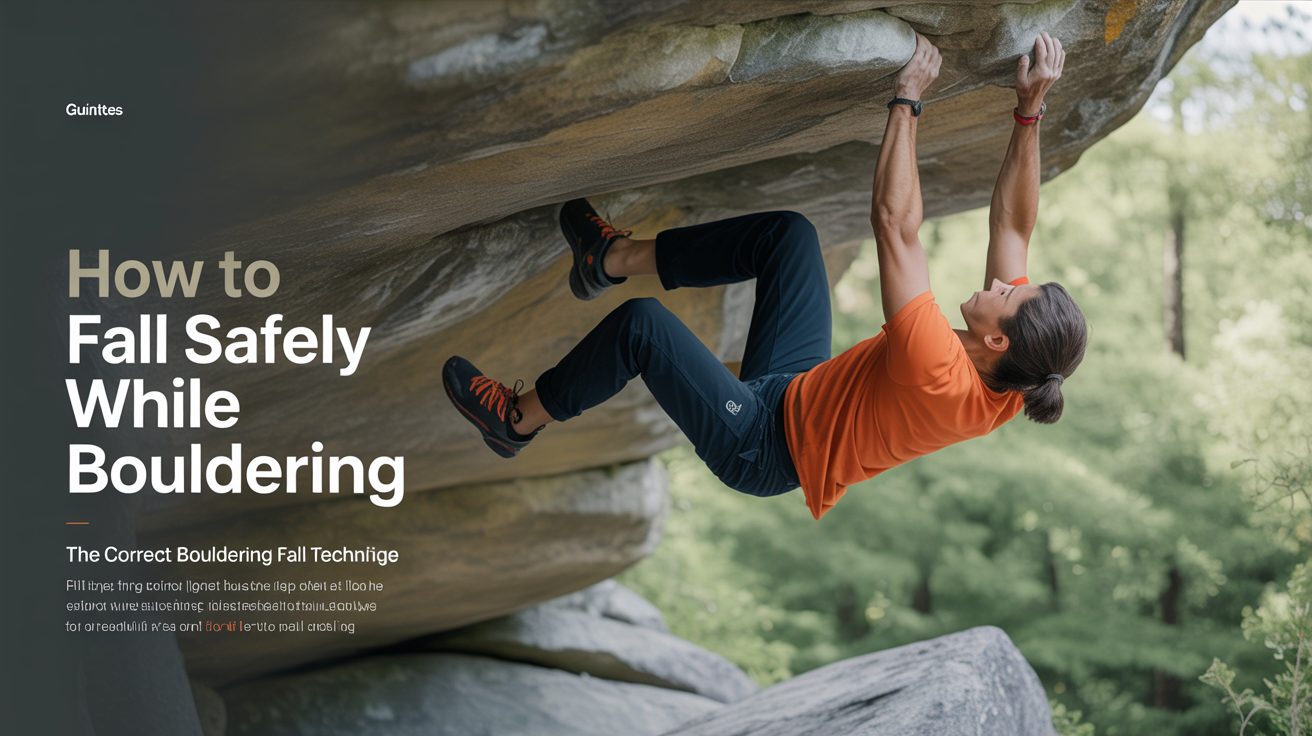
Good landings are a skill, and like any skill, they are built through intentional repetition at low stakes before you need them at high ones. Here is the sequence, step by step.
Step-by-Step Landing Sequence
- Look at your landing zone before you commit to a move. Glance down and confirm the pad is below you, no one is standing on the edge, and there are no gaps between pads large enough to trap a foot or ankle. This takes one second and removes a lot of variables.
- Let go cleanly. Do not fight or cling to the hold as you peel off. A partial grip can spin or torque your body before you land. Release deliberately.
- Keep your arms tucked or out to the sides, not extended downward. Your hands should stay off the floor. This is the hardest part. Resist the instinct.
- Spot the pad as you descend. Keep your eyes open and your awareness on where your feet will meet the surface.
- Land on both feet simultaneously with deeply bent knees. Your feet should hit close together, toes pointing forward. Think of the knee bend as a built-in shock absorber: the more bend, the more distance over which to slow down.
- Immediately initiate a backward roll. As the knees compress, let your hips drop back and down, round your spine, tuck your chin to your chest, and roll smoothly onto your upper back and shoulders. Think of it as a controlled tip backward rather than a flop.
- Do not reach back with your hands. A hand behind you while rolling is another wrist injury waiting to happen. Keep them forward or across your chest.
- Stay loose throughout. A tense body transmits force. A relaxed body dissipates it.
Practicing the Roll Before You Need It
Find the lowest section of the bouldering wall at your gym, or simply stand on a thick crash pad, and practice the landing sequence from a standing position. Drop into bent knees and roll backward until it feels smooth and automatic. Do this ten times before you ever climb above knee height. It sounds excessive until the first time your feet slip on a greasy hold and your body just does the right thing.
Setting Up Your Landing Zone
No amount of good technique compensates for a bad landing setup. Before you start a problem, take thirty seconds to check a few things.
Pad Coverage
Crash pads cover the area directly below the problem, but bouldering moves rarely send you straight down. Think about where a barn-door swing or a dynamic move might push your trajectory, and position the pad to cover that zone too. At a gym, the pads are already in place, but gaps between them can form, especially near walls and aretes. Fill gaps with a second pad or adjust your start position.
Clear the Area
Ask anyone standing on the edge of the pad to step back before you climb. A common cause of bad landings is a climber stepping onto a foot that is already occupied by someone else's bag or shoe. Call out "falling" if you feel a peel coming and people are close. Most gym boulderers develop this habit naturally, but it takes deliberate attention at first.
Down-Climb When You Can
The safest landing from any bouldering problem is no landing at all. Down-climbing (reversing your moves back to the ground instead of jumping or falling from the top) keeps you in control of your body position and eliminates unpredictable impacts entirely. It is also excellent footwork practice. Jumping from the top of a tall boulder problem puts you into a genuine fall from height, and even with good technique the impact load is significant. If you can reverse the last two or three moves, do it.
Common Mistakes and How to Fix Them
Most bad landings come down to a handful of predictable patterns. Recognizing them in yourself is most of the battle.
Hands Down
This is the most common mistake at every experience level. The hands-down reflex can also show up as reaching backward during the roll, which is equally dangerous. Drill the tuck actively. Some coaches have beginners hold a small rolled piece of tape in each hand during fall practice to make any hand contact with the floor obvious.
Knees Locked
Landing stiff-legged removes the most important shock-absorbing mechanism you have. If your landings sound loud (a hard slap rather than a soft thud), your knees are probably too straight. Think about landing "quiet."
Landing Off the Pad
Lateral drift during a fall is easy to underestimate. If you are consistently landing on the edge or off the pad entirely, the problem is usually your setup, not your technique. Move the pad, or reconsider the line of the problem. No technique fixes a structural gap in your landing zone.
Not Tucking the Chin
A chin that stays up can cause the back of your head to contact the pad during the roll. It is rarely a serious issue on a gym crash pad, but it is a bad habit to carry outdoors. Chin to chest, every time.
Building the Habit Over Time
Fall practice is boring in the same way that fire drills are boring, right up until the moment it is not. The goal is to make the correct movement pattern so automatic that adrenaline and surprise cannot override it. Spend five minutes at the start of each session dropping from the lowest holds and rolling cleanly. Do this for a month and the movement will be there when you need it.
As you progress and attempt harder, taller problems, some falls will still be outside your ability to control completely. Dynamic moves, unexpected slips, and body positions that make a clean landing impossible are all real. Even with excellent technique, bouldering carries injury risk. If a fall feels genuinely dangerous (an awkward body position, a poorly covered landing zone, or a high-consequence top-out), it is entirely reasonable to step back, down-climb, or skip the problem until conditions are better. Knowing when not to fall is part of the skill set too.
For more on getting started with the fundamentals of the sport, see our bouldering for beginners guide. If you are climbing with others, understanding spotting in bouldering is the natural next step. A good spotter can redirect a falling climber toward the pad and away from obstacles, and the two skills work together.
FAQ
Is it really that important to practice falling, or will I just figure it out?
It matters more than most beginners expect. Falling instincts under stress default to whatever your body has practiced, and the default instinct (hands out, arms rigid) is exactly the wrong one. Deliberate fall practice at low heights is what builds the override. Most people who develop wrist injuries bouldering had never intentionally practiced landing before.
What if I fall in an awkward body position and cannot do the full technique?
You will not always get a clean, textbook landing. Sideways falls, off-balance peels, and dynamic launches all create situations where the ideal sequence is not available. Do what you can: soften the knees if possible, protect the wrists, stay as loose as you can. The technique gives you a framework that applies partially even when it cannot apply fully. This is also why fall practice from many different positions, not just a straight drop, is useful.
Do I need a spotter?
At a commercial gym with padded floors and established crash pads, a spotter is not always mandatory, but it helps, especially on problems with awkward landing zones or moves that might send you sideways. A spotter's job is not to catch you but to redirect you toward the pad and keep your head from contacting anything hard. Learning to spot and be spotted is worth the time, and most gym climbers are happy to help if you ask.
How high is too high to fall without special precautions?
Indoor bouldering walls are generally built to heights where a fall is survivable with good technique and proper padding. That said, the higher the fall, the greater the impact load even with perfect form. At the top of a tall gym boulder problem, down-climbing is almost always the better choice if you have the option. Outdoors, the calculus changes significantly: natural surfaces are harder, pads are smaller, and the stakes are higher. Outdoor bouldering is a separate conversation that really benefits from going out with experienced partners who know the area.
Can I learn to fall safely just from reading about it?
Reading builds awareness; practice builds the response. This article can tell you what to do, but your nervous system will not believe it until you have done it fifty times at low height. Use this as a map, then go find an instructor or experienced climber at your gym to watch a few practice falls and give you honest feedback.