How Climbing Grades Work (V-Scale and Roped Scales)
A plain-language guide to climbing grades explained: the V-scale for bouldering, YDS for roped climbing, and what the numbers actually mean for beginners.
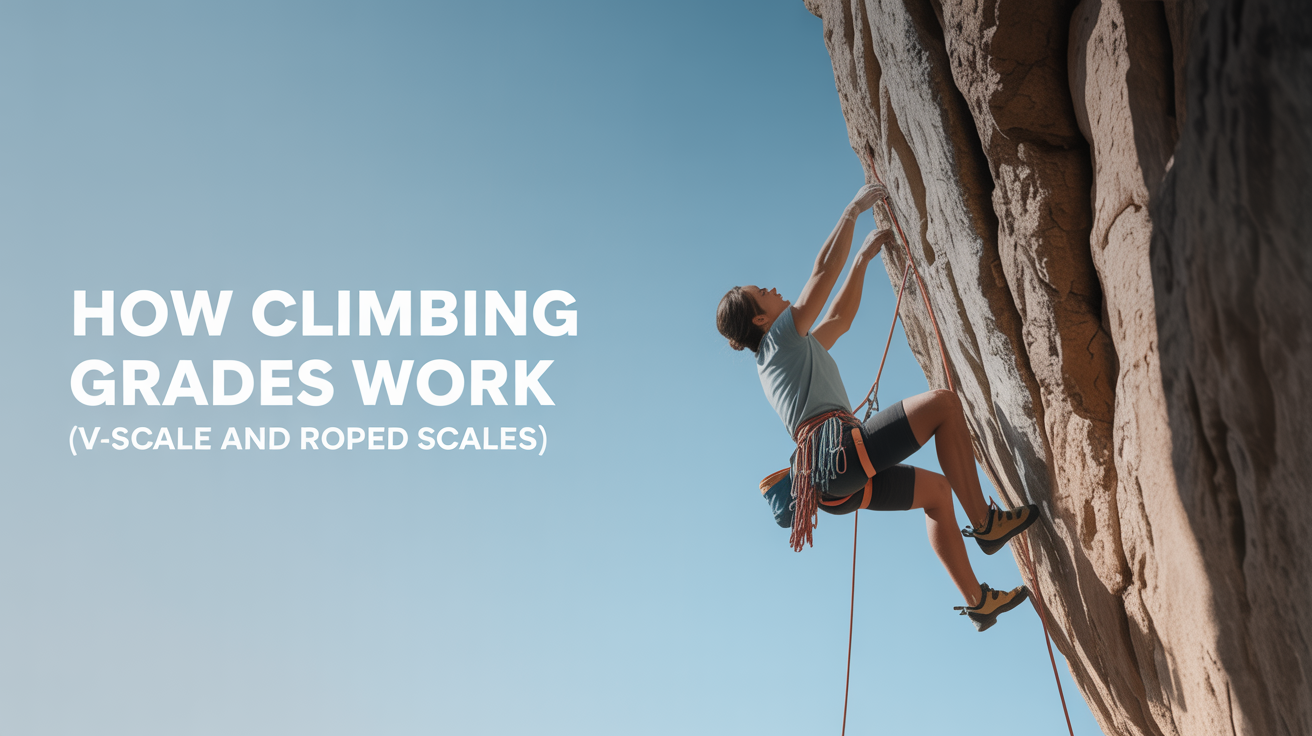
Walk into any gym and you'll see holds tagged with colors, numbers, or cryptic letter-number combos like "V2" or "5.10b." These are grades, a community-built shorthand for how hard a climb is. They're useful, imperfect, and widely misunderstood by beginners.
Here's the honest version: grades are a rough consensus, not a precise measurement. They shift between gyms, crags, and countries. A V2 at one gym might feel like a V4 somewhere else. Knowing that upfront will save you a lot of frustration and keep you focused on climbing instead of scorekeeping.
The Two Main Worlds: Bouldering vs. Roped Climbing
Grades split along a basic fault line: are you clipping a rope, or are you climbing without one?
Bouldering involves short, powerful problems climbed without a rope above a padded floor, and it uses its own number system. Roped climbing (top-rope and sport/lead) uses a different one. The two systems don't convert cleanly into each other because the disciplines emphasize different things. A hard boulder problem rewards explosive strength on a short sequence. A hard roped route might test endurance across dozens of moves.
Most beginners start on one or the other, so it helps to understand both.
The V-Scale: How Bouldering Grades Work
The V-scale was developed at Hueco Tanks in Texas by climber John "Verm" Sherman in the early 1990s. It runs from VB (the "B" stands for basic) at the easy end, up through V0, V1, V2, and keeps climbing all the way to V17, which represents the absolute frontier of human climbing ability.
For beginners, VB and V0 are where almost everyone starts. These problems usually have large holds, straightforward movement, and modest height. V1 and V2 start to introduce smaller holds, more precise footwork, and moves that require a bit of body tension. By V3 and V4, you're solidly in intermediate territory at most gyms.
There's no fixed ceiling to the V-scale. The top grade floats upward as the sport progresses. When someone climbs something harder than any existing grade, the community assigns a new number.
What "beginner" looks like on the V-scale
Most new climbers spend their first several months on VB through V2. That range is wider than it sounds: a VB at a well-set gym can still require real coordination and body awareness. Don't rush past it. Solid footwork at V0 will carry you further than muscling through V3 with sloppy technique.
The YDS: How Roped Climbing Grades Work in the US
The Yosemite Decimal System (YDS) was developed in the mid-twentieth century to classify hikes and rock climbs in the Sierra Nevada. It divides terrain into five classes, and Class 5 is where technical rock climbing lives. That's why every roped climbing grade starts with "5."
The scale runs roughly from 5.0 (very easy, like walking up a steep slab) to 5.15 (the current ceiling of elite sport climbing). The number after the decimal point matters a lot: 5.10 is several times harder than 5.6. At grades 5.10 and above, the scale adds letter suffixes (a, b, c, d) to create finer distinctions. So 5.10a is easier than 5.10d, which sits just below 5.11a.
Beginners typically find their footing between 5.5 and 5.9. Most gym top-rope walls have plenty of routes in this range. A 5.6 or 5.7 usually has good, positive holds and logical movement. By 5.9, you're starting to encounter real footwork challenges and the occasional awkward body position.
A note on the + and - system
Some older guidebooks and a handful of gyms use + and - instead of letters (for example, 5.10+ rather than 5.10c/d). It's the same idea, just a different notation. You'll mostly encounter the letter system at modern gyms.
The French Sport Scale: What You'll See in Europe and Many Gyms
If you climb in Europe, visit a gym with international influence, or look up modern sport routes online, you'll encounter French grades. They run from 1 (trivially easy) through 9c (currently the hardest route ever climbed). The system uses a number plus a letter such as 5a, 6b, or 7a, and adds a + for the upper half of each letter grade (e.g., 6b+).
French grades are the standard for sport climbing worldwide, so if you ever read about elite competition climbing or browse international route databases, this is the system being used.
Grade Comparison Table
This table gives rough equivalents across the three main systems. The word "rough" is doing real work here. Different areas and setters have their own standards, and these ranges overlap at the edges.
| Difficulty Level | V-Scale (Bouldering) | YDS (US Roped) | French Sport |
|---|---|---|---|
| Very easy | VB | 5.0 - 5.4 | 1 - 3 |
| Easy (beginner) | V0 | 5.5 - 5.7 | 4a - 5a |
| Moderate (beginner) | V1 - V2 | 5.8 - 5.9 | 5b - 5c |
| Intermediate | V3 - V4 | 5.10a - 5.10d | 6a - 6b |
| Advanced | V5 - V7 | 5.11 - 5.12 | 6c - 7a |
| Expert | V8 - V11 | 5.13 - 5.14 | 7b - 8b |
| Elite | V12+ | 5.14d - 5.15 | 8c - 9c |
Use this as a rough map, not a conversion calculator. The disciplines are different enough that a strong boulderer might struggle on long endurance routes at equivalent difficulty, and vice versa.
When Gyms Use Colors Instead of Numbers
Many gyms, especially those catering to beginners, set their routes using a color-coded circuit system rather than alphanumeric grades. Yellow holds might be beginner-level, green intermediate, red hard. The exact mapping varies by gym, and some gyms post a key at the front desk or on the wall.
This approach makes it easier for brand-new climbers to navigate without needing to decode a number system right away. The tradeoff is that color circuits don't translate outside that gym. When you move to outdoor climbing or visit a different facility, you'll want to know the standard scales.
Why Grades Are Consensus and Why That Matters
Grades are not set by a governing body or measured by a machine. A first ascentionist (the person who climbs a route for the first time) proposes a grade, and the climbing community adjusts it over time as more people climb it. This is why a grade can feel sandbagged (harder than its number) or soft (easier than its number).
Gyms complicate this further because setters have their own styles and standards. A gym that sets powerful, compression-heavy problems will feel harder at V2 than one that sets technical slabs. Neither is wrong. They're just different.
The practical upshot: when you visit a new gym or climb outside for the first time, give yourself a full session before trusting your grade sense. Start below what you normally climb. Your grade sense will recalibrate.
The Right Way to Think About Grades as a Beginner
Grades are a tool for finding appropriate climbs, not a measure of your worth as a climber. The biggest mistake beginners make is chasing numbers before their technique is ready. Jumping to harder grades too soon builds bad habits, and in climbing, bad habits lead to overuse injuries, particularly in the fingers and tendons.
The climbers who improve fastest are almost never the ones pushing their grade hardest. They're the ones climbing lots of volume on routes slightly below their limit, paying close attention to footwork, body position, and movement quality. Check out how to get better at climbing as a beginner for a more complete look at how to structure early progression.
When a route starts to feel too easy, that's a good sign. Your technique on that style of move is solidifying, and moving up a grade is a natural next step. One last thing worth saying plainly: aggressive training tools like hangboards exist for a reason, but that reason is not "I've been climbing for two months." Connective tissue in your fingers takes years longer to adapt than muscles do. If you want to understand the timeline, should beginners hangboard covers the reasoning in full.
Projecting and Grade Goals
A "project" is a climb you work on repeatedly over sessions or weeks, one that's currently beyond your flash ability. Projecting is a legitimate and rewarding part of climbing. It teaches problem-solving, persistence, and specific strength. But there's a difference between projecting mindfully and obsessing over a number.
If your only goal is to tick a grade, you'll rush moves, skip rest, and ignore what your body is telling you. If your goal is to understand why a specific sequence is hard and find a way through it, that's where real improvement happens. What is projecting in climbing breaks down how to approach a project without turning it into a source of stress.
Grade goals are fine to have. Just hold them loosely.
FAQ
What grade should a beginner climb?
Most beginners start on VB to V1 in bouldering and 5.5 to 5.8 on roped walls. These ranges are wider than they look. There's real skill to develop at every level, and movement quality matters more than the number on the hold.
Are gym grades the same as outdoor grades?
Not necessarily. Gyms and outdoor crags set their own standards, and there's often a mismatch. Many climbers find outdoor grades harder than equivalent gym grades because outdoor rock is less predictable and the holds are less obvious. Give yourself a buffer when climbing outside for the first time.
What does "sandbagging" mean?
A sandbagged route is one that climbs harder than its stated grade. The opposite (a route that feels easier than its grade) is called "soft." Both happen because grading is a community consensus, not an objective measurement. It's common to hear climbers argue about grades; it's less common for those arguments to produce agreement.
Why do different gyms feel so different at the same grade?
Setters have individual styles. One setter might favor crimps and precise footwork; another might prefer dynamic moves and compression. A V2 at one gym might have almost nothing in common with a V2 elsewhere beyond the general difficulty level. Variety in where you climb is actually valuable for this reason.
Do grades measure danger?
No. Grades measure technical difficulty, meaning how hard the moves are, not how risky the climb is. A 5.6 on a 50-meter sea cliff with poor gear placements can be far more dangerous than a 5.12 at an indoor gym. This distinction matters especially as you start climbing outdoors. Always learn safety skills such as belaying, building anchors, and falling technique hands-on with a qualified instructor, not from an article.